

Long Plush Snake Crochet Pattern in Chenille Yarn
Crochet a soft snake in chunky chenille yarn. Simple shaped head, then easy rounds of 15 sc to any length. Beginner friendly, US terms.
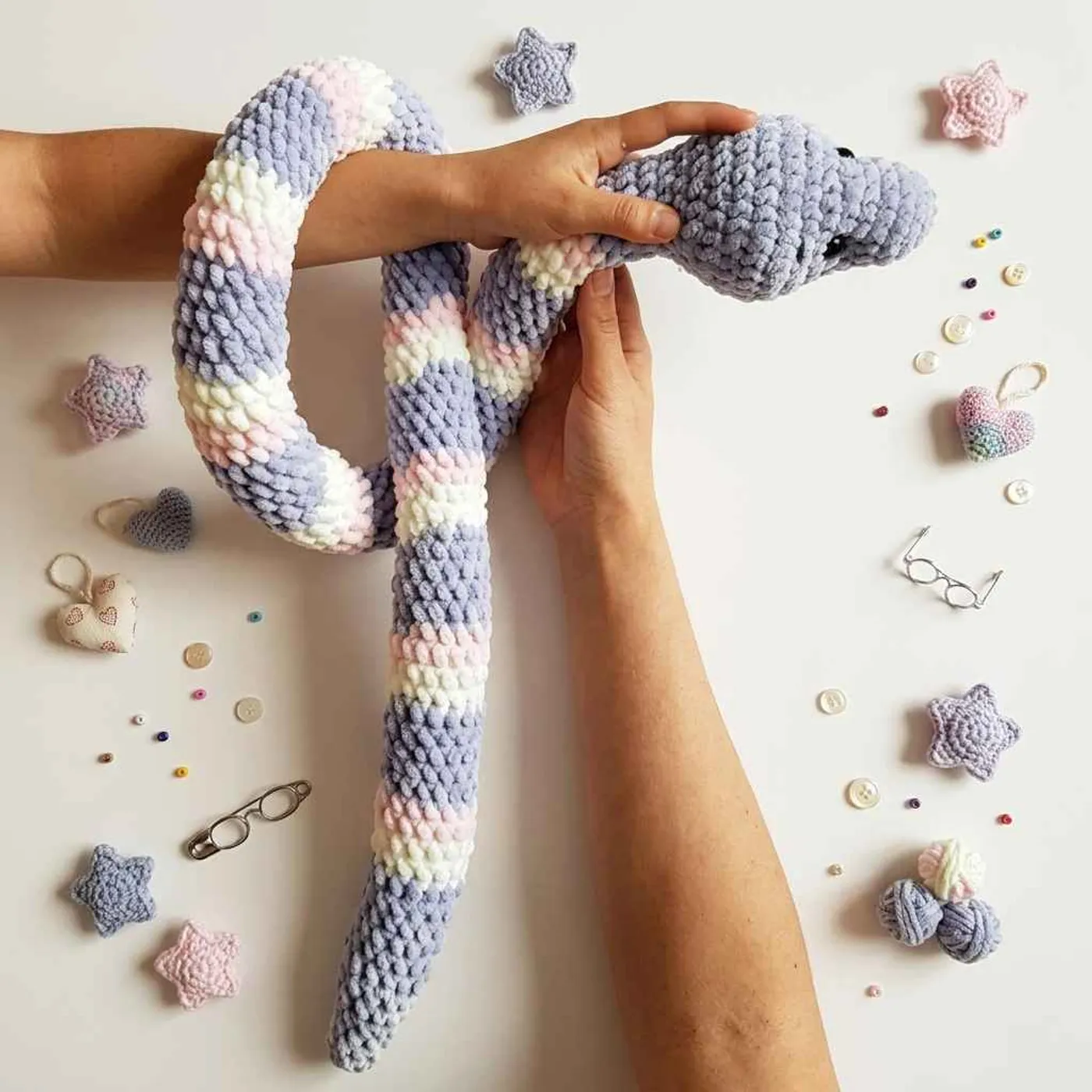
This crochet snake is a long, squishy plush made in chunky chenille yarn. The sample is about 43 in (110 cm) long, with a slightly flattened head, 12 mm safety eyes and a body you can drape around your shoulders or coil on a bed.
The pattern is very simple. You shape the head in the first 15 rounds, then crochet plain rounds of 15 sc until the snake is as long as you like. A short tapered tail closes it off.
Because the body is just repeated rounds, it is a great project for beginners and for relaxing crochet in front of the TV. The sample in the photo has lilac, pink and white stripes, but you can make it in one color or any stripe pattern you like.
The pattern is written in US crochet terms.
Finished size
The sample snake is about 43 in (110 cm) long with Himalaya Dolphin Baby chenille yarn and a 3.5 mm hook, with about 110 rounds of 15 sc for the body.
The length is up to you. Fewer body rounds give a small snake for a child, and more rounds give a giant snake. The head is 33 stitches around at its widest point.
Materials overview
- Chunky chenille / velvet yarn in your main color (lilac in the sample)
- Extra colors for stripes (pink and white in the sample), optional
- 3.5 mm crochet hook
- Safety eyes, 12 mm
- Fiberfill stuffing
- Yarn needle, scissors and a stitch marker
Yarn substitution
The sample uses Himalaya Dolphin Baby, a soft chenille yarn. Any similar plush, velvet or blanket yarn works, and gives the snake its cuddly look.
You can also use a regular worsted or DK acrylic or cotton with a smaller hook. The snake will be thinner and firmer, so add more body rounds if you want the same length.
Chenille yarn hides stitches, so use a stitch marker at the start of every round and count often.
Stitch notes
- Work loosely: the designer recommends not crocheting too tight. A tight fabric with lots of stuffing makes the snake stiff, and it will stand up like a stick instead of bending.
- Light stuffing: stuff the body gently so it stays soft and flexible.
- Spiral rounds: work in a continuous spiral and move your marker up every round.
- Stripes: to make stripes, change color in the last pull-through of the last stitch before the new color. You can carry the yarns inside the body or cut them and weave in the ends.
Common mistakes
- Overstuffing: the most common mistake with this snake. A firm, overstuffed body does not bend or drape. Stuff a little at a time as you go.
- Crocheting too tight: chenille yarn is hard to work into when the stitches are tight. Keep a relaxed tension.
- Losing count in the head: rounds 7, 8 and 12 have uneven repeats that shape the head. Follow them stitch by stitch and check the total at the end of each round.
- Waiting too long to place the eyes: put in the safety eyes before the head gets narrow and stuffed, while you can still reach the inside to attach the backs.
FAQ
When do I attach the safety eyes?
Attach the 12 mm eyes on the head after round 11 or 12, before you start decreasing much. Stuff the head and then continue with the body.
How long should the snake be?
Any length you like. The sample has about 110 body rounds and is around 43 in (110 cm). Stop the body rounds whenever the snake is long enough, then work the tail.
Are safety eyes OK for a baby?
Safety eyes can come loose with hard use. For a baby or toddler, embroider the eyes with black yarn instead.
What does shaping the muzzle mean?
The designer pulled the face in a little with a yarn needle to give the snake a defined muzzle. Pass a length of yarn through the head from side to side near the eyes and pull gently, then secure it. This step is optional.
Head
Start with your main color.
Rnd 1: 6 sc in MR (6)
Rnd 2: inc 6 times (12)
Rnd 3: (1 sc, inc) x 6 (18)
Rnd 4–5: 18 sc (18) (2 rounds)
Rnd 6: (5 sc, inc) x 3 (21)
Rnd 7: 3 inc, 8 sc, 3 inc, 7 sc (27)
Rnd 8: (1 sc, inc) x 3, 8 sc, (1 sc, inc) x 3, 7 sc (33)
Rnd 9–11: 33 sc (33) (3 rounds)
Rnd 12: dec, 15 sc, dec, 5 sc, dec, 7 sc (30)
Attach the safety eyes now and start stuffing the head lightly.
Rnd 13: (3 sc, dec) x 6 (24)
Rnd 14: (2 sc, dec) x 6 (18)
Rnd 15: (4 sc, dec) x 3 (15)
Body
Rnd 16 and on: 15 sc in every round (15)
Repeat this round until the snake is the length you want. The sample has about 110 rounds. Change colors for stripes if you like, and stuff lightly as you go.
Tip: stuff every 10–15 rounds. It is much easier than pushing stuffing down a long, narrow tube at the end.
Tail
Rnd 1: (3 sc, dec) x 3 (12)
Rnd 2–3: 12 sc (12) (2 rounds)
Rnd 4: (2 sc, dec) x 3 (9)
Rnd 5–6: 9 sc (9) (2 rounds)
Rnd 7: (1 sc, dec) x 3 (6)
Rnd 8: 6 sc (6)
Add a little stuffing to the tail if needed. Fasten off, thread the tail through the front loops of the last stitches, pull tight to close, and hide the yarn end inside the snake.
Finishing
- Check the eyes are secure and the head is lightly stuffed.
- If you like, shape the muzzle by pulling a length of yarn through the head near the eyes and securing it.
- Weave in any loose ends from color changes inside the body.
Optional & Creative Ideas
- Stripe patterns: copy the lilac, pink and white stripes from the sample, or try rainbow stripes, a zigzag of two colors or a single bold color.
- Forked tongue: chain a few stitches in red, split the end into two short chains and sew it under the muzzle.
- Mini snake: work only 30–40 body rounds for a small pocket snake.
- Draft stopper: make the body long enough for a door and stuff it a little firmer to block drafts.
Final Thoughts
This snake is a relaxing make once the head is done, and the plush yarn makes it irresistible to cuddle. Keep it soft and lightly stuffed so it drapes and curls just like the one in the photo.
Patterns and instructions on OpenCrochet are for personal use. Please do not redistribute copies of this content; share the page link instead.


